
HOOSIER TRAILS COUNCIL · SCOUTING AMERICA
Researched. Planned. Now in Motion.
Vision for Growth
A three-year strategic plan to make Hoosier Trails Council a top-10 council nationwide — built with our board, our district leaders, and our frontline volunteers across all 18 counties.
Published June 2026
18
counties served
3-Year
strategic plan
10
priorities, field-validated
4
district listening sessions
OUR WHY
Why We Set Out to Grow
Every family deserves access to what Scouting offers: confident young people, capable leaders, and communities that look out for one another. Over the past five months, Hoosier Trails Council took a hard, honest look at where we stand and where we want to be — and built a plan to get there with discipline and excellence at the unit level.
“Hoosier Trails Council will be a top-10 council nationwide in membership growth, retention, and financial stability because we deliver Scouting with discipline and excellence at the unit level. We are building a welcoming, mission-driven Scouting community where youth and volunteers thrive in a safe, supportive environment.”
— HTC Vision Statement, adopted January 31, 2026
This report shares what we researched, what we planned, and what we are now executing — openly, so that families, donors, partners, and volunteers can see the road ahead and walk it with us.
THE DESTINATION
One Vision, Three Trails, One Summit
We organized our ten priorities into three trails. Each climbs from a different starting point and converges at a single summit — our share of Scouting America’s national goal of 2 Million Youth Served. The map below is how we keep everyone moving in the same direction.
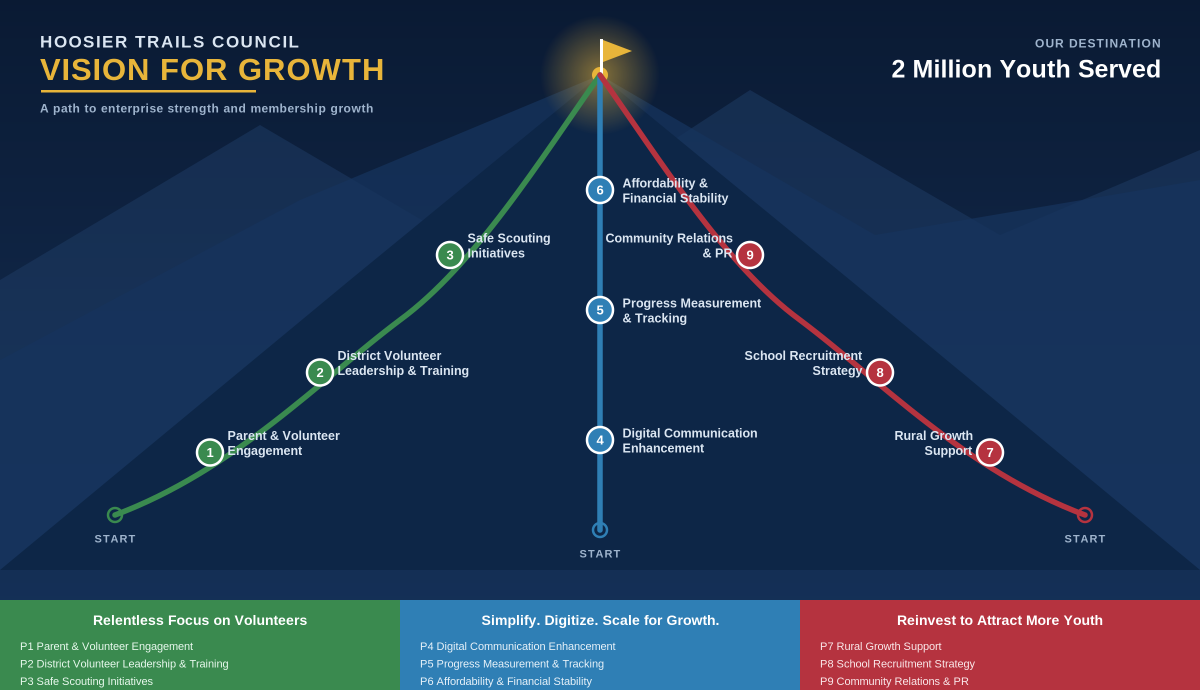
Green — Volunteers
Building people and community: parent & volunteer engagement, leadership & training, and Safe Scouting.
Blue — Simplify. Digitize. Scale.
Systems and clarity: digital communication, progress tracking, and affordability & financial stability.
Red — Attract Youth
Investment and reach: rural growth, school recruitment, and community relations & PR.
WHAT WE RESEARCHED
We Asked the Right People the Right Questions
Good plans start with listening. Our vision was developed, tested, and adopted through three deliberate stages — each one widening the circle of people who shaped it.
STAGE 1
Executive Committee Vision Workshop
Drafted the vision and ten priorities. Adopted January 31, 2026.
STAGE 2
Frontline Leader Fireside Chats
Four district sessions validated and enriched every priority with real-world input.
STAGE 3
Board Wrap-Up & Adoption
Turned learning into named owners, 12-month goals, and 90-day first steps. May 30, 2026.
What our frontline leaders told us
Across Hoosier Hills, White River Trails, Wapehani, and Lenni Lenape, leaders described what success would actually look like in their units. Six themes came back again and again:
- Engaging parents and volunteers is the number-one need. On-the-spot adult registration at events, skills-matched roles, and family campouts that turn new parents into believers.
- Communication must meet people where they are. Low-volume text alerts for big news, plain language without acronyms, and a council Facebook page that partners with unit pages.
- Affordability is about value and access. Shift the story from cost to investment, a simple checkbox for aid, multi-child discounts, and clear explanation of where fees go.
- Safety should be visible, not just a checkbox. A ‘safety minute’ to open every meeting, flexible in-person training, and QR codes at camp activity areas.
- Visibility drives growth. Share recent activity and Eagle projects, partner with Lions, VFW, and churches, and reconnect with groups like 4-H.
- Rural access magnifies every other challenge. Rotate council-wide events across counties, localize activities to cut travel, and help rural units find sponsors and charter partners.
National validation: Scouting America’s Trail Map (released May 15, 2026)
HTC’s priorities — built independently — mapped onto all three national pillars. HTC went further than the national model with two additions that reflect who we are: Safe Scouting as standalone, non-negotiable infrastructure, and Rural Growth Support, essential for an 18-county council.
WHAT WE PLANNED
Ten Priorities for Year One
Out of everything Scouting could chase, these ten passed our test — what our own people, in our own districts, told us matters most.
1. District Volunteer Support
Goals: Establish district lead volunteer structure, strengthen volunteer support systems, create a sustainable leadership pipeline, improve coordination across all 4 districts.
First steps: Build District Leadership Teams anchored by four named District Commissioners. Contact every unit scoring 0–2 on the engagement metric and move it toward 3.
2. Community Relations & PR
Goals: Build community awareness of Scouting, strengthen local partnerships, position the council as a youth-development leader.
First steps: Grow board-led community speaking engagements and local partnerships. Share recent activity and Eagle projects to counter the ‘Scouting isn’t active’ narrative.
3. Digital Communication
Goals: Enhance the council’s digital presence, improve cross-generational communication, streamline collaboration tools.
First steps: Publish top parent & leader Scoutbook how-to videos on the council YouTube. Evaluate a texting service for mass announcements.
4. Progress Measurement
Goals: Create easy-to-understand metrics, establish feedback loops, develop visual progress tracking, align measures with the council vision.
First steps: Stand up a progress + alerting mechanism with a public ‘done / in-progress / next’ status view. Track unit engagement using National’s 0–5 Scoutbook engagement score.
5. Affordability & Financial Stability
Goals: Reduce program costs for families, improve financial sustainability, eliminate financial barriers to joining.
First steps: Launch the New Scout Access Fund to remove startup cost barriers. Create parent & youth value statements and an assistance-program list.
6. Safe Scouting Initiatives
Goals: Strengthen Safeguarding Youth protocols, increase safety awareness, ensure compliance with safety standards, build a safety-first culture.
First steps: Launch Roundtable 2.0 with safety moments and Safeguarding Youth protocols. Open every meeting with a brief ‘safety minute.’
7. STEM & Youth Recruitment
Goals: Build STEM education partnerships, grow youth membership through programming, attract diverse youth populations.
First steps: Convert STEM partners into traditional units and brand STEM content. Continue well-received STEM events that bring families in.
8. School Recruitment Strategy
Goals: Establish year-round school presence, increase recruitment in schools, build relationships with administrators, position Scouting as an education partner.
First steps: Conduct Scout Talks and host Sign-Up Nights across local schools. Train volunteers to deliver effective school presentations.
9. Parent & Volunteer Engagement
Goals: Understand parent & volunteer needs, improve onboarding & training, increase retention & satisfaction, build a strong volunteer community.
First steps: Make unit-by-unit volunteer needs (especially recruiting) the deliverable. Register attending adults on the spot and match skills to roles.
10. Rural Growth Support
Goals: Assess and understand rural unit needs, support rural growth with tailored programs, build rural community partnerships, reduce barriers to rural participation.
First steps: Strengthen chartered organization relationships beyond the annual signature. Pair rural units with stronger ‘cousin’ units nearby.
WHAT WE'RE EXECUTING
From Plan to Action
On May 30, 2026, the board turned the priorities into commitments. We organized the work into four streams. You’ll notice our three trails became four streams here: as we moved from vision to execution, we gave Affordability & Financial Stability its own dedicated stream — with its own set of goals — rather than folding it into another trail. Money touches every priority, and giving it focused ownership has proven to be the right call.
1. Relentless Focus on Volunteers
Parent & Volunteer Engagement · Volunteer Leadership & Training · Safe Scouting
We are building district leadership teams anchored by four named District Commissioners, reaching every unit that needs a closer connection, and launching Roundtable 2.0 with safety moments and Safeguarding Youth protocols. Unit-by-unit volunteer needs — especially recruiting — become the deliverable, with adults registered on the spot and matched to roles that fit.
2. Simplify. Digitize. Scale for Growth.
Digital Communication Enhancement · Progress Measurement & Tracking
We are publishing parent and leader Scoutbook how-to videos on the council YouTube, creating community-content forms to feed the website and social media, evaluating a texting service for mass announcements, and standing up a public ‘done / in-progress / next’ status view so progress is visible to everyone.
3. Reinvest to Attract More Youth
Rural Growth Support · School Recruitment · STEM & Youth Recruitment · Community Relations & PR
We are converting Science, Technology, Engineering, and Math (STEM) partners into traditional units, conducting Scout Talks and Sign-Up Nights in local schools, growing board-led community speaking and partnerships, strengthening chartered organization relationships beyond the annual signature, and pairing rural units with stronger ‘cousin’ units nearby.
4. Affordability & Financial Stability
Affordability · Financial Stability
This is the stream we deliberately broke out on its own. We are launching the New Scout Access Fund to remove startup cost barriers, creating parent and youth value statements alongside an assistance-program list, providing uniform-flexibility guidance for families and leaders, and tracking every funding stream — Friends of Scouting (FOS), foundations and trusts, product sales, and other sources. Giving the money its own focus, with multiple goals beneath it, is what makes the rest of the plan affordable to deliver.
Why a fourth stream? In our research the three trails captured the shape of the work — building people, simplifying systems, and reinvesting to reach youth. But affordability runs underneath all three. By naming it as its own stream, with its own goals and its own reporting, we made sure it could never quietly slip to the bottom of someone else’s list. That decision has already paid off in focus and follow-through.
Why a fourth stream? In our research the three trails captured the shape of the work — building people, simplifying systems, and reinvesting to reach youth. But affordability runs underneath all three. By naming it as its own stream, with its own goals and its own reporting, we made sure it could never quietly slip to the bottom of someone else’s list. That decision has already paid off in focus and follow-through.
OUR SHARED FILTER
The Celery Test
To keep us aligned as the work begins, we adopted a simple filter from Simon Sinek’s Start With Why. Imagine a dinner party where everyone gives you business advice — M&Ms, Oreos, rice milk, celery. If you buy it all, your cart is just a pile of other people’s good ideas. But if you know your why — ‘only do what’s healthy’ — you walk past the M&Ms and buy only the celery and rice milk. The why is the filter. And once it’s clear, anyone who knows it can shop for the council and come back with the right cart.
These ten priorities are our celery.
- Does this serve our why — stronger units, supported leaders, more youth reached?
- Or is it just a good idea someone heard somewhere?
- If it’s an M&M, cross it out. Keep the celery.
ONE TEAM
Volunteers and Professional Staff, Aligned
This is not a staff plan or a volunteer plan — it is a shared one. The owners are deliberately a mix of both. Adult volunteers carry items like the Access Fund, value statements, funding-stream tracking, and chartered organization coordination, while our professional staff — the District Scout Executives — anchor unit contacts, committee-chair training, and the engagement metric alongside our four District Commissioners. Every priority has a volunteer and a professional pulling in the same direction. Our guiding principle: we are here to support, not govern.
STAYING ACCOUNTABLE
We Will Report Back — Openly
We will report to our board and our districts on a regular cadence, sharing what is working and, just as honestly, where we are stuck:
- Monthly check-ins with a public ‘done / in-progress / next’ status view.
- First engagement data by the end of June, then a 90-day mark around August 1.
- A 90-day financial report on the funding streams, with the Access Fund tracked to its 8/15 goal.
- Quarterly review of all four priority groups — with board approval required before any new task is added.
JOIN THE CLIMB
This vision belongs to all of us.
Whether you’re a parent, a volunteer, a donor, or a community partner, there is a place for you on this trail. Volunteer with a unit, support the New Scout Access Fund, partner with us as a chartering organization, or simply help spread the word that Scouting is alive and growing across all 18 counties.
Thank you to every board member, district leader, and frontline volunteer who shaped this vision. It reflects who we are and who we serve.
Hoosier Trails Council • Scouting America • Published June 2026